Field dispatch
Fledge Day, from the Cup to the Carpet
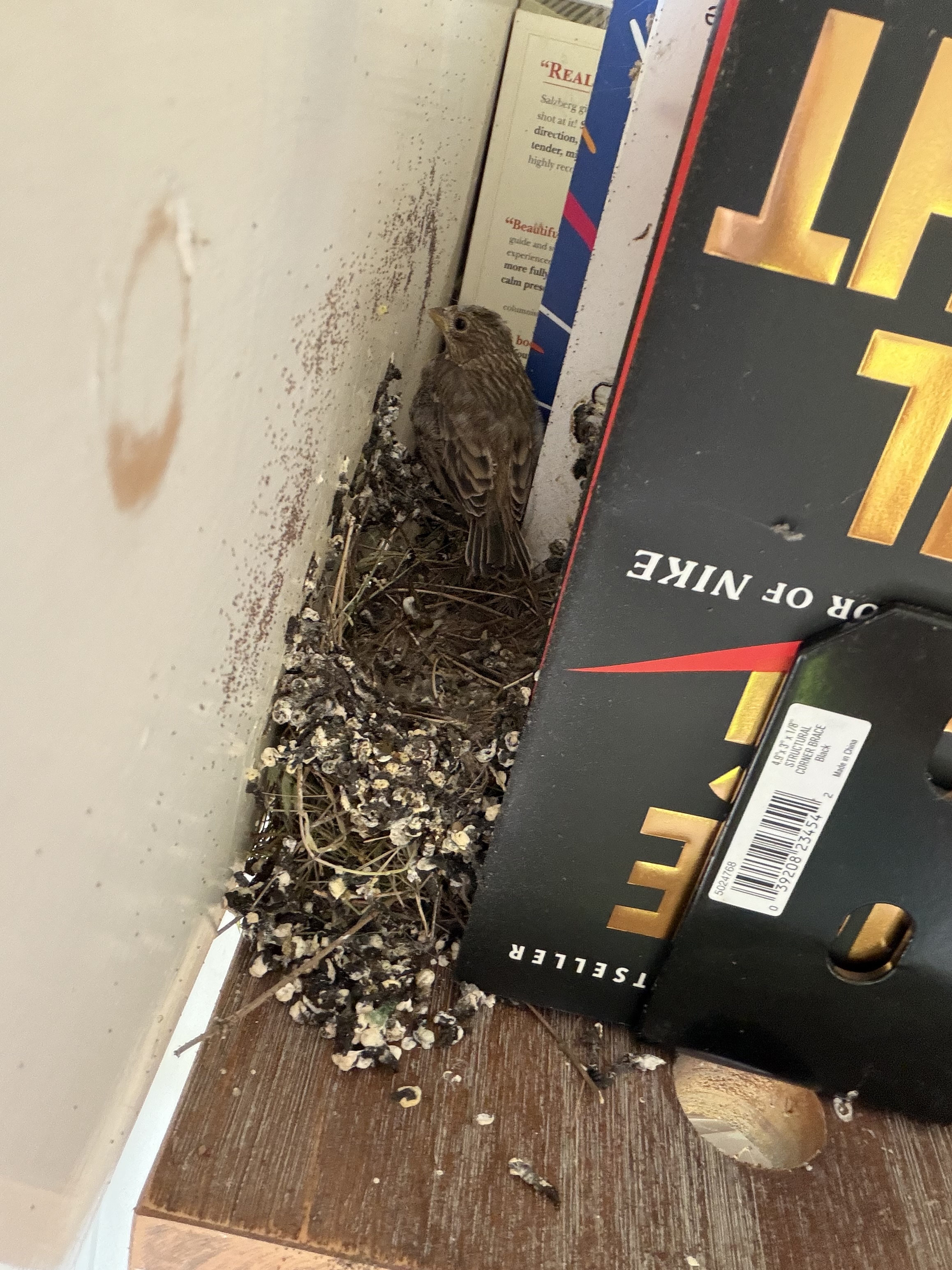
By the time Casey came to the window at 14:58 on Sunday afternoon, one chick was left.
The cup that had held five well-feathered nestlings on Friday morning had, by the night before, become a shelf rather than a vessel — the woven structure had given out under five well-fed bodies, and by early Sunday the chicks were standing on the bookshelf surface outside the cup, pecking at spilled seed, being fed on the flat wood by the female. The cup had not just been outgrown. It had collapsed.
The exit, when it came, was not gradual. It came in two pieces, separated by six hours and most of a day, and the second piece only happened because the parents kept coming back to ask.
The morning wave — fourteen minutes, four chicks gone
The first piece is on the close camera, between 09:12 and 09:26 PT. Walked frame by frame, the sequence is tight enough to lay out almost minute by minute.
At 09:12:34 the first chick crossed the wooden divider that separates the nest shelf from the launch perch — the narrow strip of wood at the lip of the sunroom window. It stood there facing out. Eight seconds later it fanned its wings. This was the moment that ended the cup as the brood’s address. From this point on, the cup was a place chicks left.
Then dad arrived. At 09:12:48 he appeared at the bottom of the close-camera frame, perched outside on the cable that runs across the sill — red crown and breast unmistakable, the standard adult-male House Finch flush. He stayed about fifteen seconds. He came back. At 09:13:50 he landed on the wood beam itself, right beside the chick that was already staging there, and the sunroom camera caught his silhouette on the outer window divider one second before the close camera had him in the frame. He left within ten seconds. He did not bring food. He brought a launch.
The first chick fledged at some moment between 09:14:20 and 09:14:29 — eight seconds in which the launch perch went from occupied to empty. The motion sensor on the room-side camera fired at 09:14:27, presumably the wingbeat.
A second chick climbed onto the wood beam by 09:15:24. By 09:15:32 it was upright in the same launch posture the first had used; by 09:15:40 it was leaning further out over the window edge; by 09:15:48 leaning further still. Then the camera went quiet for two minutes and twenty-four seconds — the longest motion gap of the morning to that point — and when the camera woke again at 09:18:17, the perch was occupied by what was either the same chick still composing itself or, more likely, the next one. Somewhere in that silent window, fledge number two.
Two long static stretches followed. From 09:18:17 to 09:19:48 the picture barely changed: one chick in what was left of the cup, one chick upright on the launch perch, both posing. Then a five-minute, seventeen-second motion gap — the longest of the day so far — and when motion next triggered at 09:25:05, the cup chick had disappeared. Fledge number three, invisible.
The fourth was caught on camera. At 09:25:51 the launch-perch chick was leaning hard over the window edge; at 09:25:59, eight seconds later, the perch was empty. The room camera triggered at 09:25:43 — likely the lead-up motion. By 09:26:31 the close camera had one bird in frame: a small, brown-streaked chick curled into the remains of the cup, alone.
Four chicks. Fourteen minutes. Two visible launches and two that happened in the gaps between motion events.
The one that stayed
The chick still in the cup at 09:26 was almost certainly the late hatchling — the runt. House Finch broods hatch over a day or two, and the bird that comes out last is the bird that spends the next two weeks on the wrong end of every feeding scrum, parked toward the back of the nest while the older siblings press to the front for the parent’s bill. By Day 17 the gap is visible: smaller body, less fuel, less practice working the launch perch. While four siblings had been jostling each other over the lip of the window from dawn, this one had been sitting in a corner of the cup, waiting for the room to clear.
Now the room had cleared, and the parents started coming back to do the work they had not been able to do during the brood’s feeding chaos. The next ninety minutes of close-camera footage are mostly the runt alone in the cup, broken by three short visits. Each one was different. Together they read like a sequence.
09:59 — the female demonstrates
At 09:59:14, the female landed on the wood beam — the same launch perch the four siblings had used. Brown plumage, no red, unmistakably her. The chick was curled deep in the cup, head tucked. Within nine seconds she was in active demonstration posture: wings partially spread, body leaning hard over the divider edge toward the open window. By 09:59:26 her tail was raised and fanned, and the chick had come fully out of its curl, body upright, beak open, in the classic gape-and-beg of a bird expecting to be fed.
She did not feed it. She stayed on the perch eighteen seconds, in active leaning posture the entire time, and then at 09:59:32 the perch was empty — she had launched out herself, demonstrating the path. The chick stayed in the cup, watching where she had been. By the end of the clip it was at the cup’s edge, feathers slightly raised, but it had not committed.
10:17 — the male flies through
Eighteen minutes later, the male did a faster version of the same demonstration. At 10:17:00 he was already on the launch perch, body angled toward the open window, red throat visible. Three seconds later the perch was empty. Almost a drive-by. He did not enter the cup, did not feed, did not stop. The chick, head still tucked, did not appear to react. The whole visit fit inside the gap between two camera frames.
The reading: watch me, this is how, I’m doing it now. Showing, not telling. Telling, at this point in a House Finch’s development, is not on the menu.
10:35 — the male brings food
The third visit was the one that changed posture. At 10:35:45 the male was already inside the cup itself — not perched on the launch beam, in the cup, body angled down into the nest, red face and breast clearly visible at the lower edge of the frame. The chick was underneath him, head raised toward his beak.
Three seconds later, at 10:35:48, the camera caught the feeding cleanly in a single frame: chick’s gape wide open, dad’s head bent down into it, bill-to-bill alignment, the textbook adult-to-juvenile food transfer. By 10:35:51 he was gone. The whole provisioning visit had taken about six seconds.
What it told the chick — and what makes it the most consequential of the morning’s three visits — was that food was still on offer, but the food came to the place the food had always come to, the cup, and the cup was the place where the siblings used to be, and the siblings were now somewhere outside the window. The arithmetic was not yet wing-driven, but it was visibly shifting. In the frames after this visit, the chick is no longer deep-tucked — it is up, head raised, looking around.
The slow afternoon
The strategy continued through the early afternoon at lower frequency. By 12:38 a single adult was feeding the single large, fully-feathered chick at the cup. By 13:39 the female made one more visit. Then the cup was quiet for an hour and a half, while she sat briefly in it through the early afternoon — a hen returning to a finished room — and the male visited her on-nest at 13:32, 13:36, 13:41 in what reads, in retrospect, like a pair recalibrating to a configuration without nestlings.
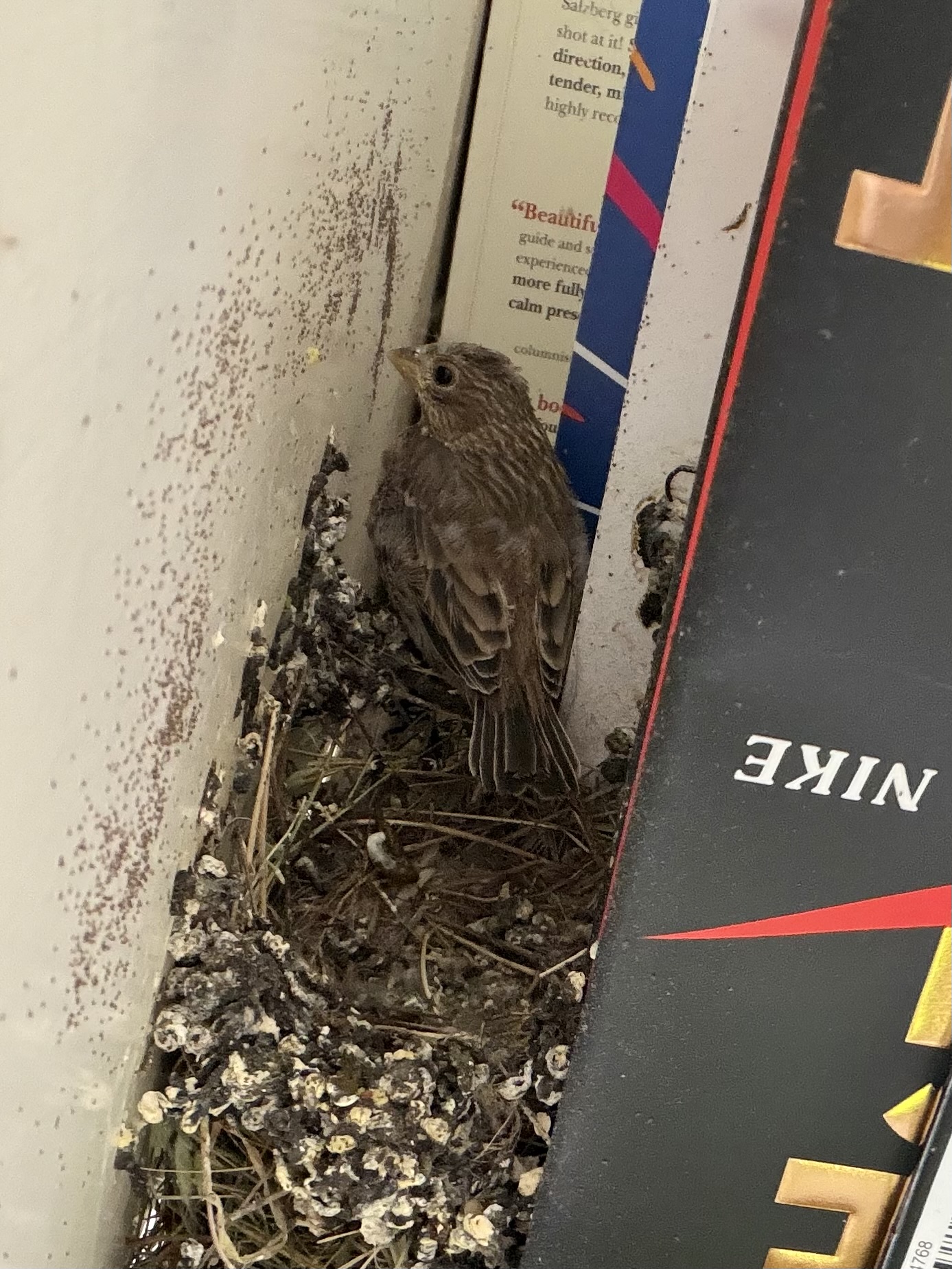
By 14:58, when Casey came to the window with the iPhone, the chick was awake, eyes open, perched on the rim of its own deteriorated nest among the spilled seed husks and the accumulating mess of seventeen days of provisioning. It did not look like a bird about to leap. It looked like a bird that had spent the morning being shown twice and fed once, and was now alone with that information.
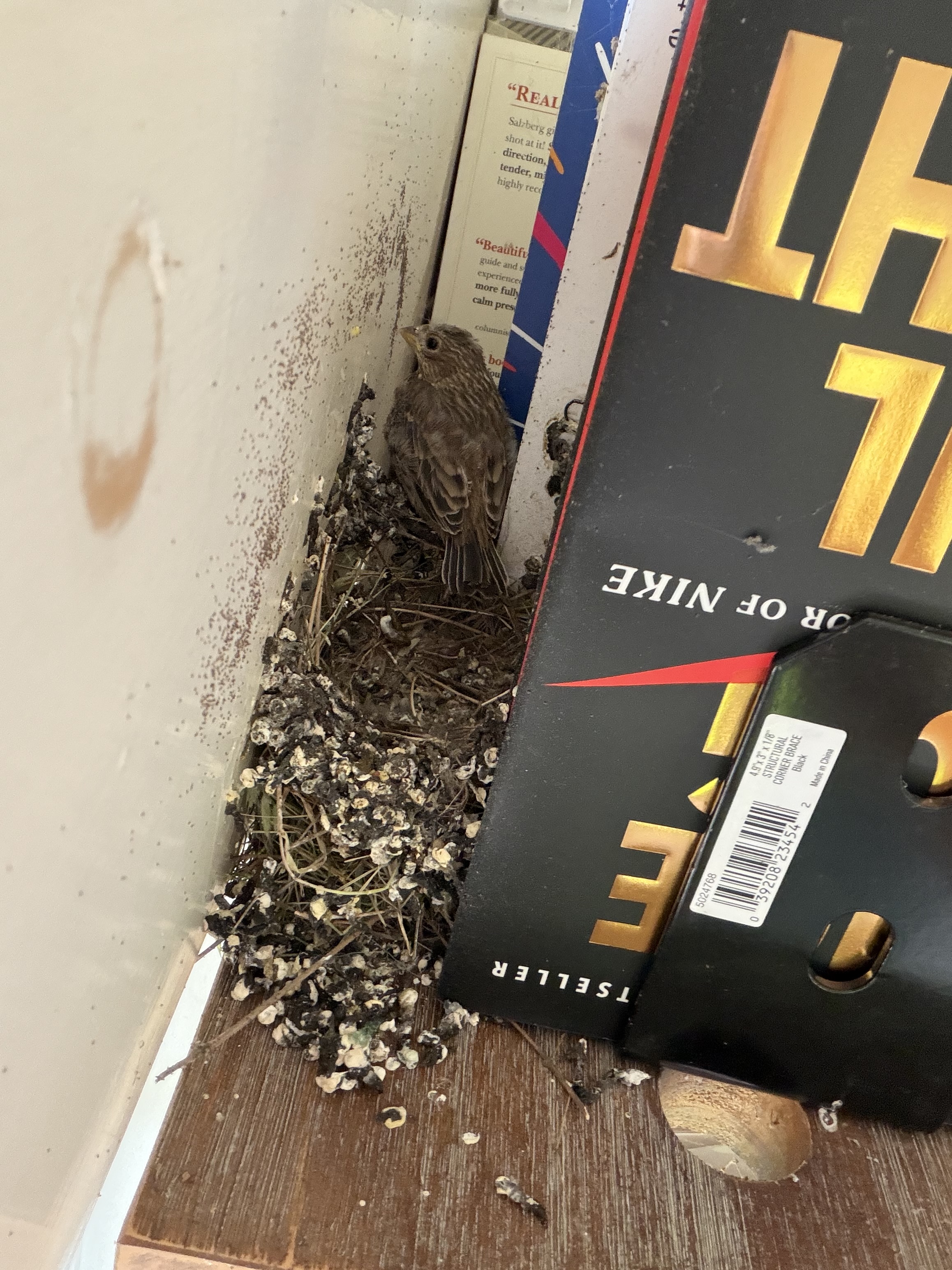
15:03 — the disappearance
At 15:03 the close camera caught what may have been the same chick six seconds before it disappeared.
The fifth fledge happened the same way the third one had at 09:25 — invisibly, in the gap between two motion events, with the perch full in one frame and empty in the next. The only difference was that this one had taken six hours longer, and had needed three coaching visits and at least one direct feed to get there.
Two minutes after that clip ended, Casey found the fledgling on the carpet under a stool at the other end of the sunroom.
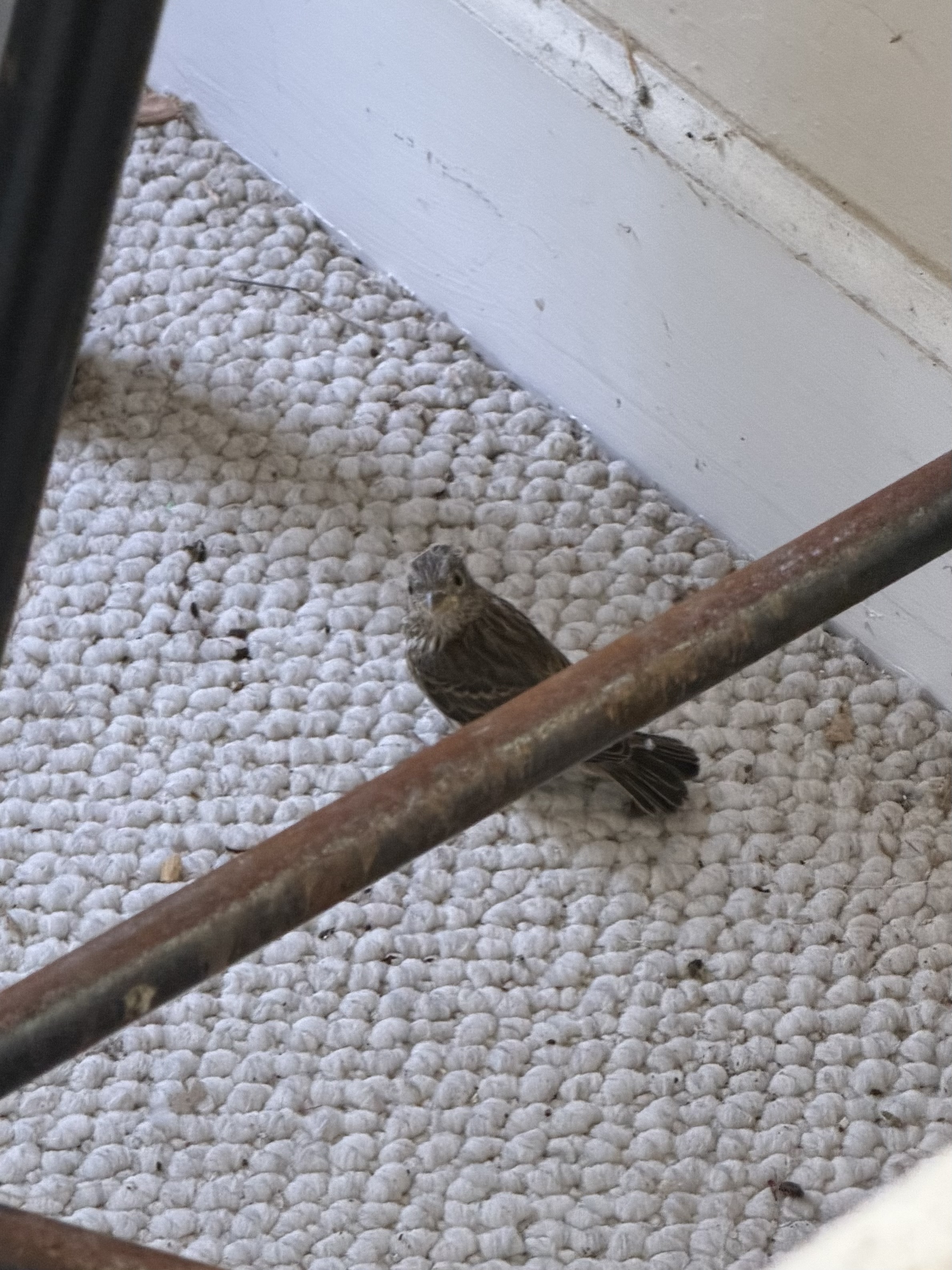
It had cleared the cup, cleared the bookshelf, cleared at least four feet of horizontal distance through the sunroom air, and landed upright on the wool weave. From the camera’s vantage, this bird had simply vanished. From the floor’s vantage, it had arrived.
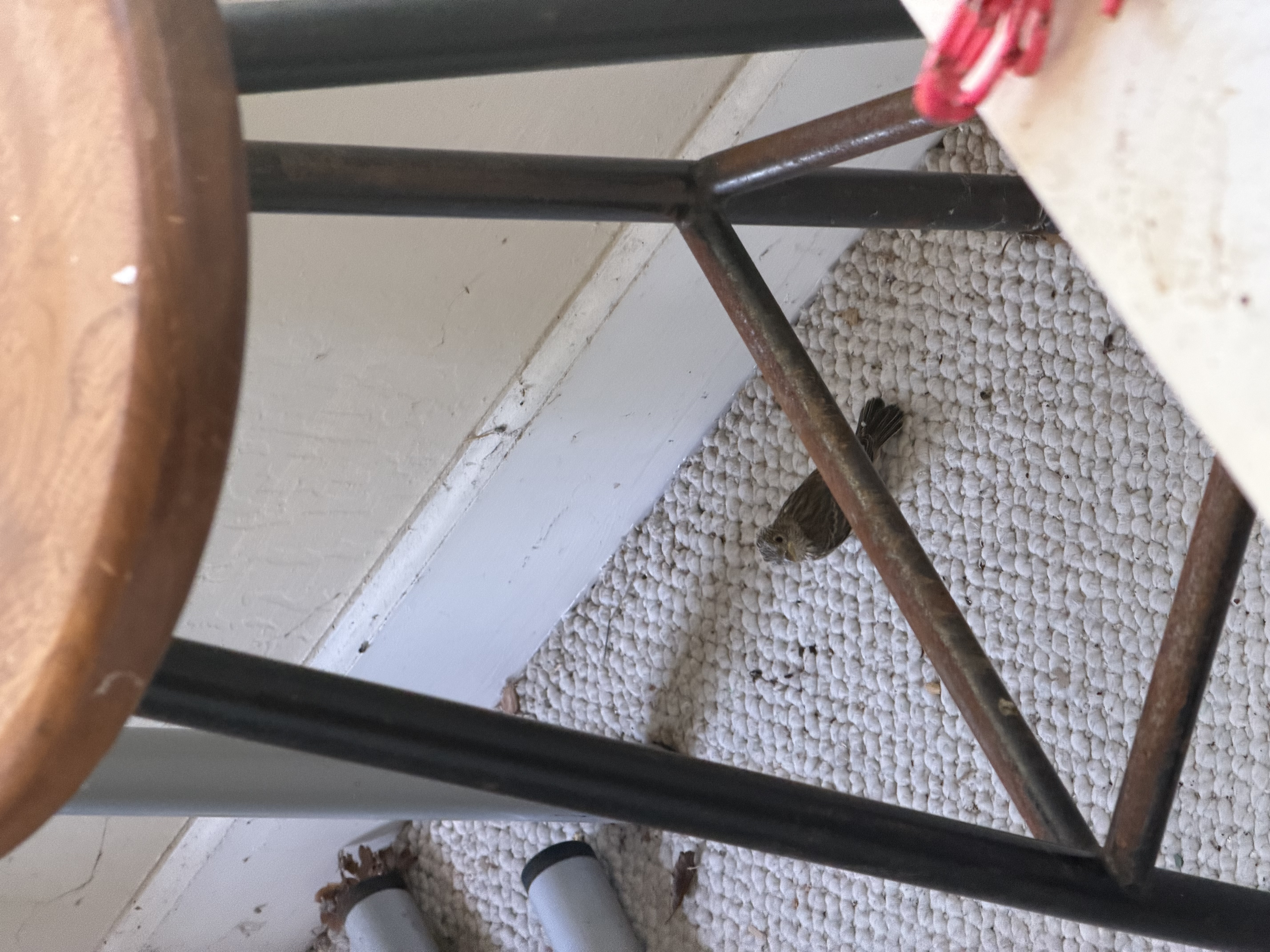
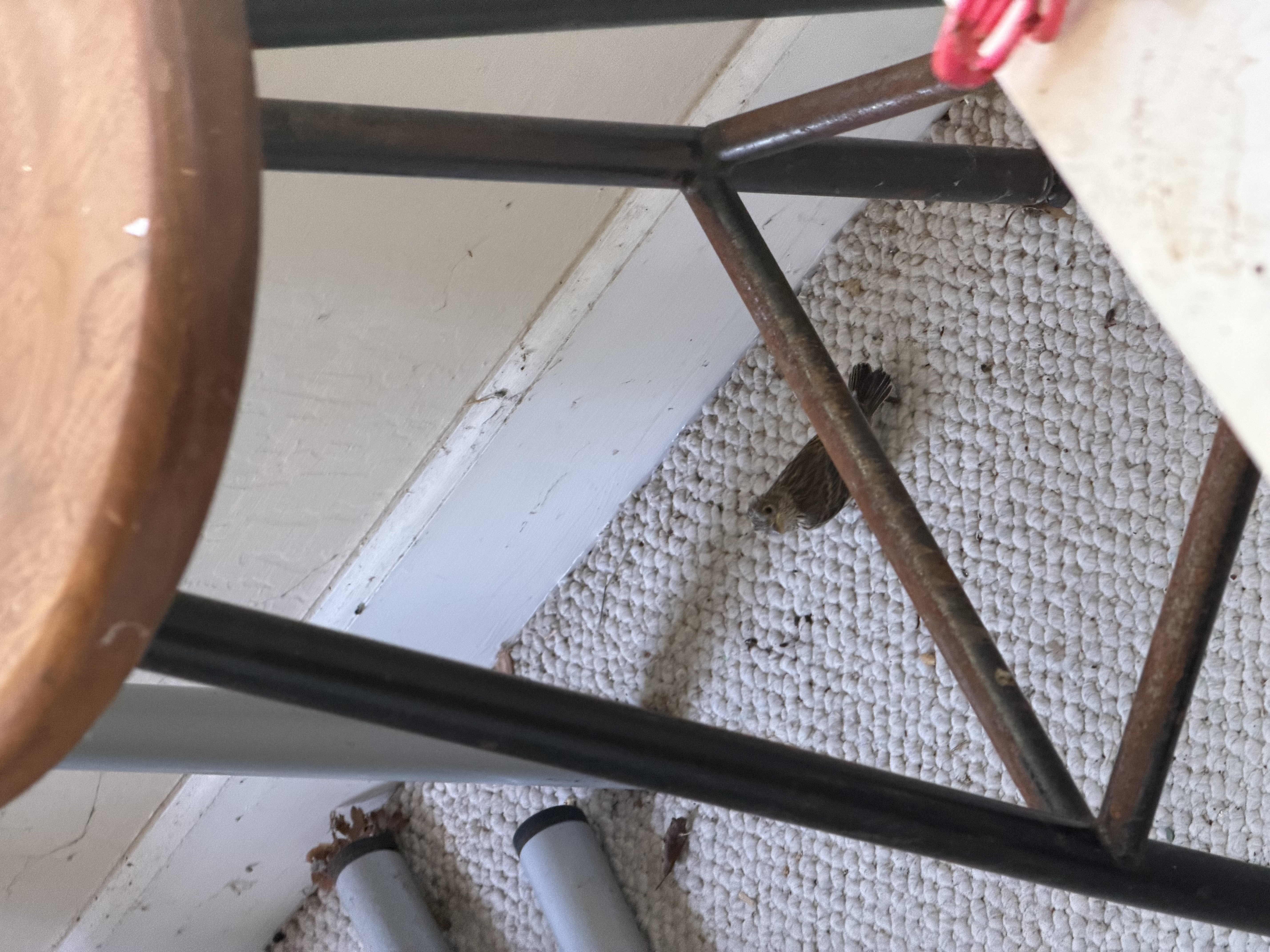
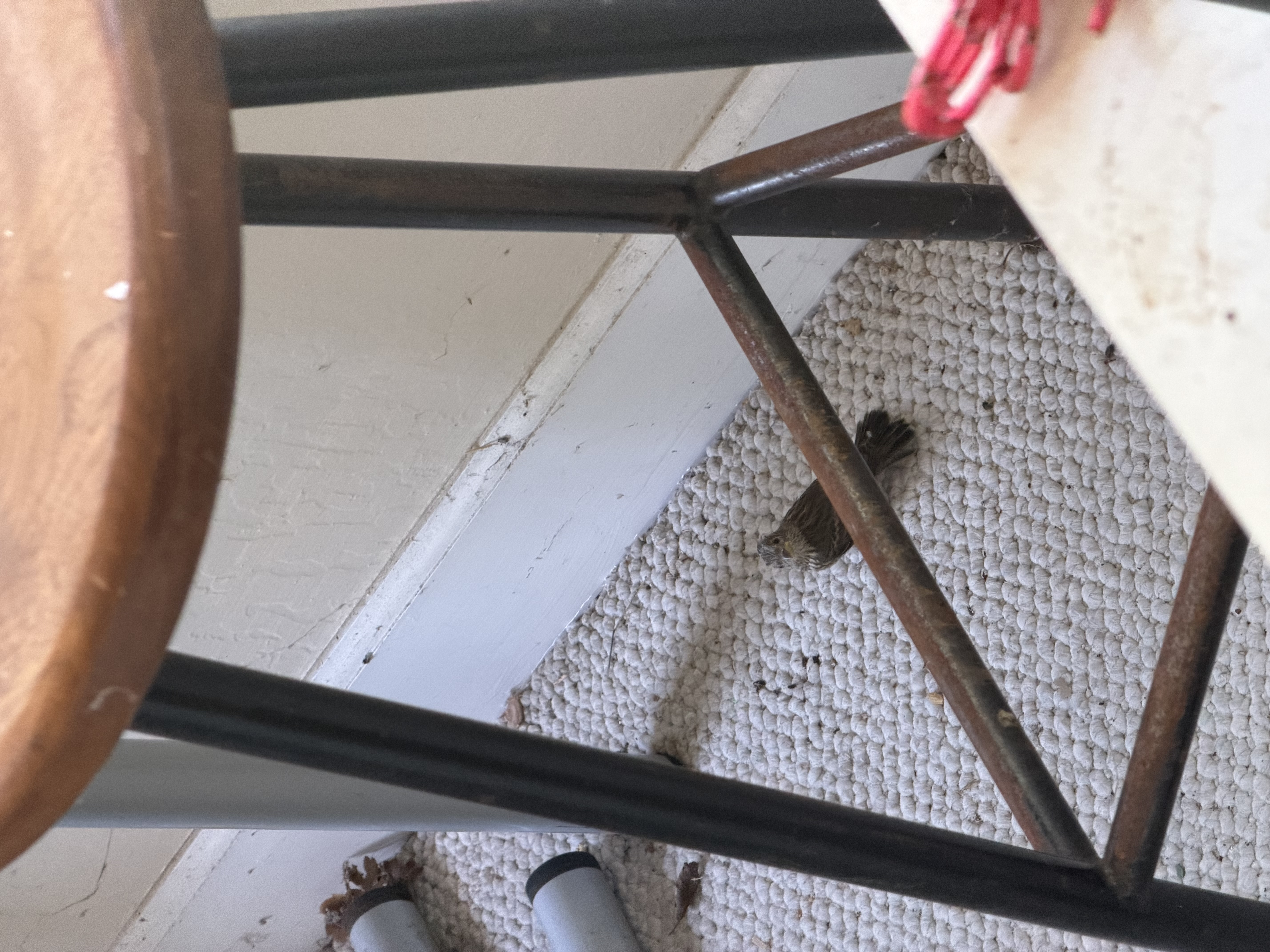
A minute later Casey closed the distance and got the close shot.
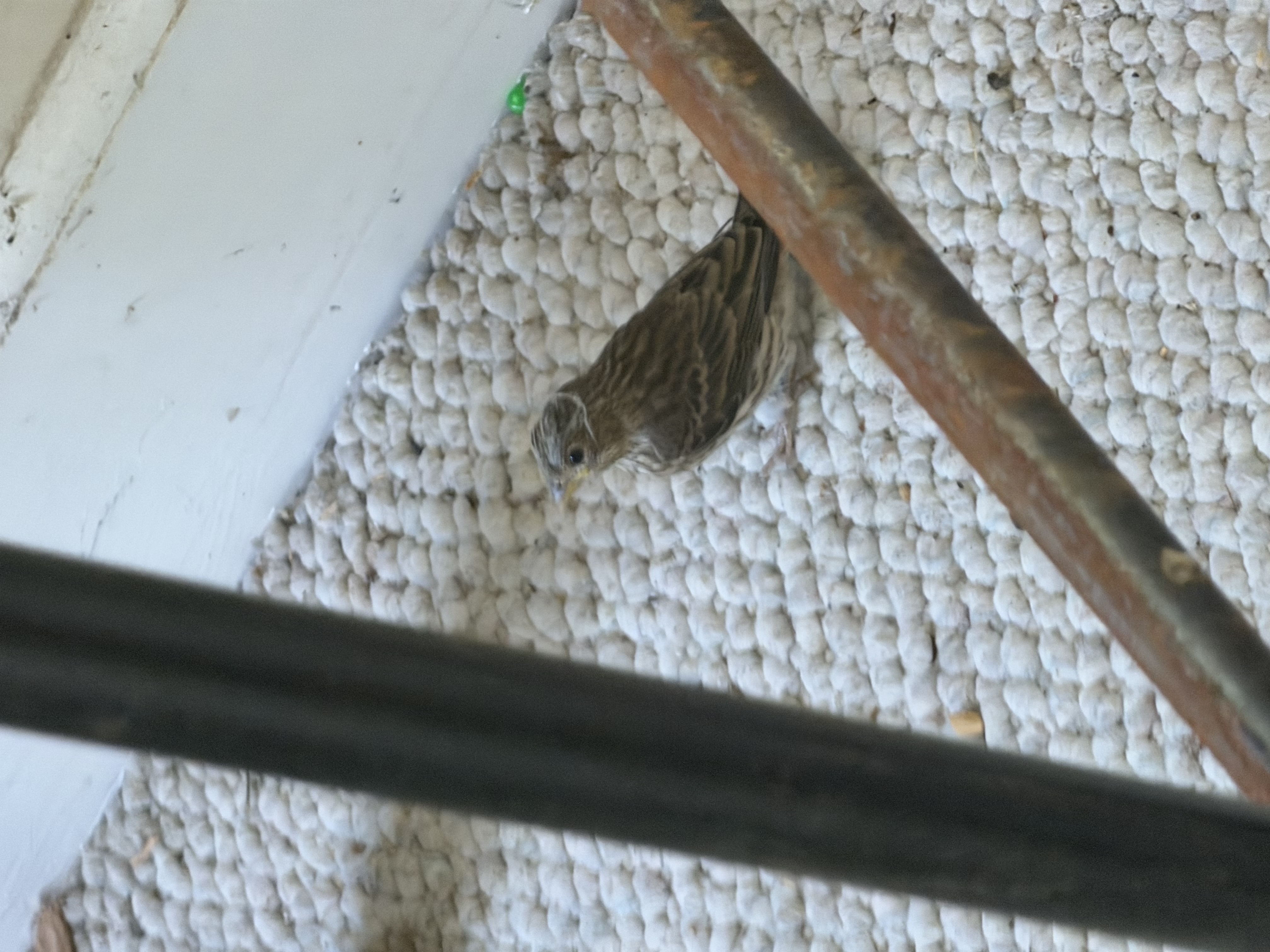
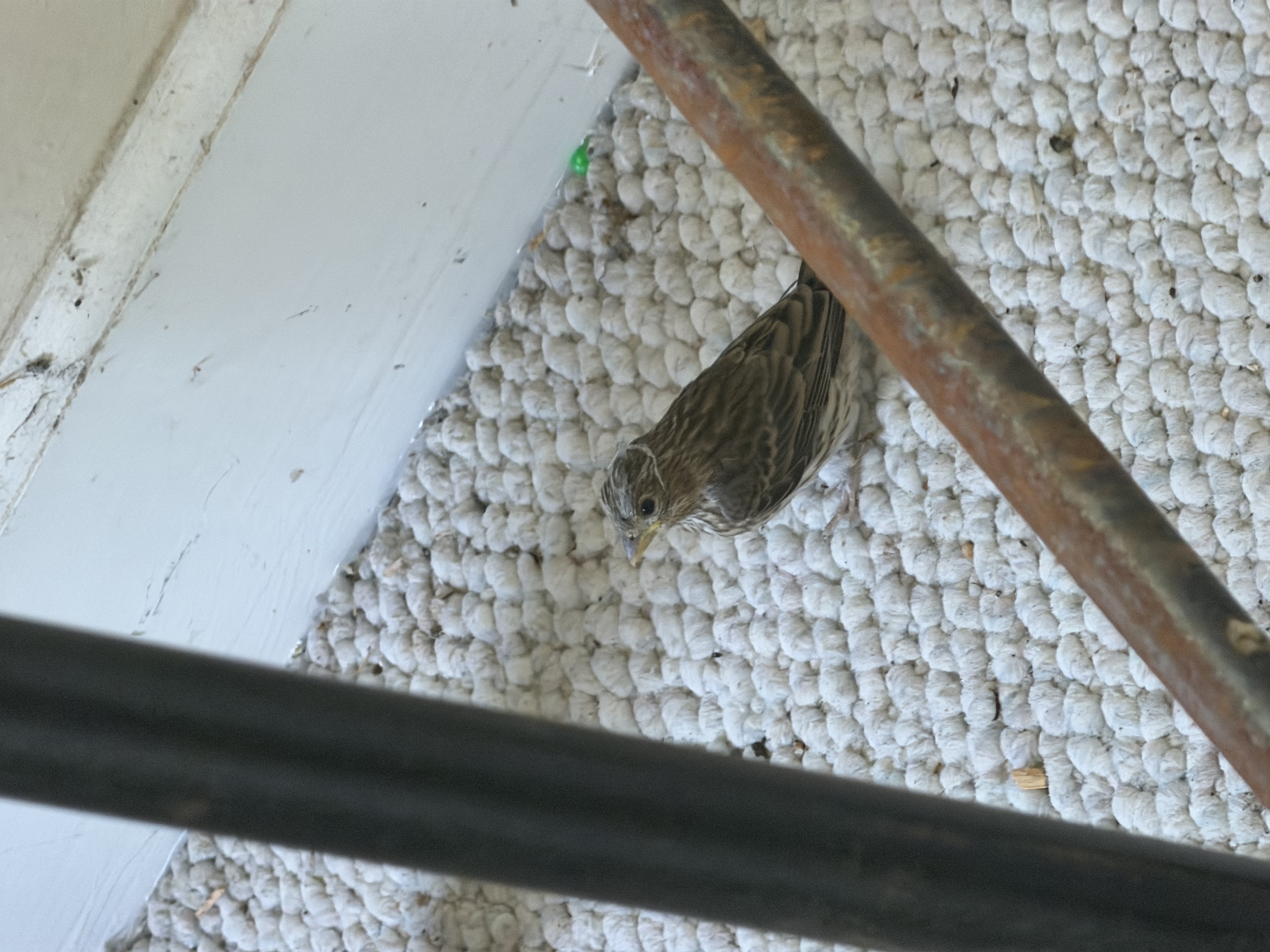
The Tapo close-camera log records “person logged near window at 15:06” — that’s Casey, kneeling on the sunroom floor with the iPhone, taking the photos above. The interval clip a few seconds later shows the cup officially empty. Forty-seven seconds after that, at 15:07:22 PT, the interval camera made the absence formal. By then the fledgling had been off the carpet and back into the wider room for some time, and the camera record was reporting the structural fact: the cup, like the brood, had moved on.
What the cameras say the day actually was
Day 17 post-hatch sits squarely inside the textbook House Finch fledge window of 12 to 19 days. What the textbook does not say, and what eight hours of camera footage plus two minutes of iPhone photography do, is that this fledging was two events, not one.
The first was a fourteen-minute wave between 09:12 and 09:26 — four chicks out of five, in the order they could work themselves to the launch perch, with the male’s two short morning visits acting as the catalyst that pushed the first one over the edge. By 09:26 the cup held one bird, the late hatchling who had spent two weeks at the back of the queue.
The second event was the rest of the day. Three short visits from the parents over forty minutes — demonstrate, demonstrate, feed — set up a long slow shift in posture from deep-tucked to alert. Continued lower-frequency visits through the afternoon kept the calorie account from emptying. The launch, when it finally happened around 15:03, happened the same way the morning ones had: in the gap between two motion events, with the perch full in one frame and empty in the next.
Five birds. Two waves. One carpet. The brood is somewhere in the trees outside the sunroom window. The cup, like the upside-down Shoe Dog underneath it, has gone back to being furniture.